Showing posts with label Intentional torts. Show all posts

Friday, May 23, 2025

Illinois Supreme Court declines to recognize a claim for interference with the parent-child relationship

Last Thursday, the Illinois Supreme Court published an opinion in a case called Hulsh v. Hulsh in which it declined to recognize a cause of action for interference with the parent-child relationship.  The issue in the case started when the mother of two minor children successfully regained custody of her children in an action filed in federal district court in Illinois against the children’s father.  The mother then filed a state court action in Cook County against her former mother-in-law and brother-in-law, alleging tortious interference with her custodial rights and aiding and abetting tortious interference with her custodial rights, seeking to recover the expenses that she incurred in the federal district court action to regain custody of her children.

The Cook County circuit court dismissed those claims for failure to state a claim, and the appellate court affirmed the dismissal pointing out that Illinois courts have declined to recognize a cause of action for tortious interference with a parent’s custodial rights, regardless of the damages claimed.  

The defendants appealed to the Supreme Court and the court affirmed and explicitly stated that it preferred to defer the question of whether to recognize such a cause of action to the legislative branch.  

You can find a copy of the opinion in the Illinois Supreme Court website.  Go here and scroll down or search by date.

Tuesday, May 25, 2021

ALI adopts Restatement Third on Intentional torts to persons

Last week, at the ALI's Annual Meeting, the membership approved the Restatement (Third) of Torts:  Intentional Torts to Persons.  The ALI's press release is here.

Saturday, October 20, 2018

Interesting case in the Fifth Circuit Court of Appeals regarding false imprisonment

Suppose a person is charged of and convicted of a crime he or she did not commit and is later exonerated.  Should that person have a claim for false imprisonment?  against whom?  and when would the statute of limitation begin to run? 

These are some of the issues addressed by the US Court of Appeals for the Fifth Circuit in a recent decision in which it  reversed and remanded dismissal of a false-imprisonment claim against the city and county of El Paso holding that false imprisonment is a continuing tort in Texas.  The case was brought by a man who spent 17 years in prison for a sexual assault he did not commit.

You can read the opinion here.

Sunday, July 15, 2018

Third Circuit: US is immune from liability for intentional conduct by TSA officers because they are not "law enforcement officers" under the FTCA

As you probably know, the Federal Torts Claims Act retains immunity in a number of very specific circumstances.  Thus, according to the Act, the United States generally enjoys sovereign immunity for intentional torts committed by federal employees.  However, this rule is subject to an exception which waives immunity for a number of intentional torts if they are committed by employees who qualify as “investigative or law enforcement officers.” 28 U.S.C. § 2680(h).  This means that a plaintiff does not have a right to recover from the US Government if a mail carrier commits battery; but may have a right to recover if an FBI agent does.

In a recent case decided by the Third Circuit Court of Appeals, the court decided that TSA agents do not qualify as "law enforcement officers" and, therefore, the Government is protected by immunity.

The case is Pellegrino v. The TSA (available here), and the facts are what you would expect given the topic:  a passenger alleged intentional torts related to the conduct of TSA officers during a "screening" at an airport.  The details of the event are described here.

Be careful when reading comments on the case because some of the discussion is a bit inaccurate.  For example, some of the stories state that the officers are immune.  This is not entirely accurate because the FTCA deals with the immunity of the Federal Government, not of the individuals. 

Simple Justice has a comment here.

Tech Dirt has a comment here.

Saturday, November 4, 2017

Utah nurse who was unjustifiably arrested for refusing to comply with illegal order by police officer agrees to $500,000 settlement

You probably remember the story from a few months ago involving a police officer who arrested a nurse after she refused to draw blood from an unconscious patient because the police officer did not have a warrant.  The police officer arrested the nurse and placed her in a squad car for some time before releasing her.  A video of the incident went viral, and the story gained national attention.  Eventually, the police officer was fired.  Since then, the hospital changed its policies and no longer allows police officers access to patient care areas.

At the time, I remember thinking this seemed like an easy false imprisonment case.  And it now certainly looks like it was.  Just a couple of months removed from the incident, there is news that the nurse has agreed to a half a million dollar settlement.  

The ABA Journal has the story with links to more information.  Here is the original video:

Tuesday, January 31, 2017

Do you remember Katko v Briney (the spring gun case)? Here is the lawyer who represented the defendant!

Way back when you took Torts, your probably read a case discussing whether a property owner can "defend" property from trespassers by using a spring gun.  The case is in every Torts casebook I have reviewed, and Prosser's even has a photo of the defendant.

In any case, the defendant's lawyer was interviewed recently and you can read the interview  here.  The 93-year-old just retired after 66 years of practice.  His reaction when Katko came to him with the case:  "Damn, this will be fun."

Thanks to the TortsProf blog for the link.

Thursday, May 21, 2015

Illinois Supreme Court holds proximate cause applies to intentional tort claims, which precludes claim for death caused by suicide but contradicts itself in the process

Back in April I wrote a comment on an oral argument before the Illinois Supreme Court in an interesting case that asked the court to recognize a cause of action for wrongful death when the defendant’s alleged intentional infliction of emotional distress caused the decedent to commit suicide.  As I explained there, Illinois has decided that, in the context of a negligence claim, a suicide is unforeseeable as a matter of law, which means that it always operates as a superseding cause that defeats the element of proximate cause.  What made the case before the Court different, however, is that it was brought as an intentional tort claim based on intentional infliction of emotional distress.  The case is called Turcios v. DeBruler Company

In my original post, I quoted a popular Torts hornbook which states that “[a]uthority is sparse as to when, if ever, proximate cause will preclude liability for intentional torts. In light of the greater culpability inherent in intentional wrongdoing, courts appear, at the very least, ready to stretch to find liability."

It is now clear that the Illinois Supreme Court is not willing, much less, ready, to make this “stretch.”  In reaching its decision, the Court first concluded that the concept of foreseeability, embodied in the doctrine of proximate causation, limits the liability of both negligent and intentional tortfeasors, holding that “[p]laintiffs’ view, under which legal cause plays no role in the liability of an intentional tortfeasor, essentially creates open ended and limitless liability for injury, no matter how abnormal, extraordinary, irregular, or remote the injury may be.” [Interestingly, the court noted that plaintiffs conceded during the oral argument that some line drawing must be made, and that an intentional tortfeasor is not necessarily liable for all  consequences flowing from the defendant’s conduct. You can listen to the oral argument here.]

Having decided that intentional tort liability should be limited by applying the concept of proximate cause, the Court then applied the proximate cause analysis to the context of the case and concluded, as it has done consistently in the past, that because the death of the decedent was the result of a suicide, it was unforseeable, and therefore the plaintiff failed to satisfy the element of proximate cause.

In reaching this conclusion, however, and perhaps without noticing it, the Court contradicts its long held position on suicide and opens the door for future arguments against it when it states:
"Because an intentional tortfeasor’s liability is limited by the concept of foreseeability embodied in the doctrine of proximate causation, a cause of action for wrongful death predicated on a suicide allegedly brought about by the intentional infliction of emotional distress is subject to the general rule that suicide is unforeseeable as a matter of law. Thus, the plaintiff bears a heavy burden of pleading and proving facts that would overcome application of the rule.

....

Accordingly, we hold that where, as here, a plaintiff seeks to recover damages for wrongful death based on the decedent’s suicide allegedly brought about through the intentional infliction of emotional distress, the plaintiff must . . . plead facts which, if proven, would overcome application of the general rule that suicide is deemed unforeseeable as a matter of law. In other words, a plaintiff must plead facts demonstrating that the suicide was foreseeable, i.e., that it was a likely result of the defendant’s conduct."
Here is what I find interesting about this.  If a plaintiff can argue that the suicide is foreseeable, then by definition, the suicide is no longer unforeseeable as a matter of law.  If it can be argued that in some cases it is foreseeable while it is not in others, then the court is implying that reasonable people could disagree as to whether it is foreseeable at all, making the question one for the jury.  Doesn't that, by definition take the question out of the realm of "a matter of law"?  And, if this is the case, then what the court is implying is that when applying the proximate cause analysis to cases where the injury is death by suicide, the analysis should be the same as in all other cases, ie, to determine if the injury is a foreseeable consequence of the risk created by the conduct.

Thus, the way I am reading this, while reiterating its long held position on whether suicide is foreseeable, the court is actually abandoning it.

The case is Turcios v. DeBruler Company and you can read the opinion here.

Sunday, April 5, 2015

Illinois Supreme Court considers whether to recognize a cause of action for wrongful death as a result of intentional infliction of emotional distress when the decedent commits suicide

About two weeks ago, the Illinois Supreme Court heard oral arguments in an interesting case that asks the court to recognize a cause of action for wrongful death when the death was caused by the decedent's suicide.  The case is called Turcios v DeBruler Company.

Illinois has decided that, in the context of a negligence claim, a suicide is unforeseeable, which means that it operates as a superseding cause that defeats the element of proximate cause.  This makes it almost impossible for a plaintiff to recover for wrongful death in a case involving suicide if the claim is based on negligence.  Turcios, however, was brought as an intentional tort claim based on intentional infliction of emotional distress.

Much of the oral argument is devoted to the question of whether "proximate cause" should be considered to be an element in an intentional tort claim.  If so, the defendant argues, there is no cause of action because it has already been decided that a suicide is a superseding cause that defeats the element of proximate cause.  If not, the plaintiff argues, all that matters is whether the intentional conduct is a cause in fact of the injury in which case the plaintiff can establish the prima facie case.

The plaintiff's position is consistent with the typical analysis in other jurisdictions.  In intentional torts cases, proximate cause is typically not an issue.  As Diamond, et al, state in Understanding Torts (4th ed.), p. 188:
"Proximate cause rarely becomes a factor in intentional torts cases, because those cases do not ordinarily test the limits of what should constitute legal responsibility.  Authority is sparse as to when, if ever, proximate cause will preclude liability for intentional torts. In light of the greater culpability inherent in intentional wrongdoing, courts appear, at the very least, ready to stretch to find liability."
And this is precisely what the plaintiff in Turcios is arguing: that because of the significant difference in terms of culpability between conduct that is negligent and conduct that is intentional, the notion of cause in intentional torts cases should not be limited by the analysis of proximate cause.

However, the plaintiff's argument is not necessarily consistent with the language used by the Illinois Supreme Court in the past.  While in many states courts say that a plaintiff in an intentional tort case must show simply "causation," (and usually appear to interpret this to mean only cause in fact), the Illinois Supreme Court has stated the plaintiff must show "proximate cause" usually then adding that proximate cause means cause in fact and legal cause.

You can listen to the oral argument here.  (Note it is very unusual in that the justices do not ask a single question during the appellant's argument!)

UPDATE:  5/16/15 The Appellate Strategist has a a comment on the case here.

UPDATE: 5/21/15:  The Illinois Supreme Court issued its opinion on the case today.  Go here to read my comment on the opinion and for a link to the opinion itself.

Monday, November 3, 2014

Podcast on Georgia case regarding parents liability for negligence in handling child's use of social media

A few days ago, I reported on a recent case in which the Georgia Appellate Court held that parents could be held liable for failing to supervise their children use of social media, or perhaps more importantly, for failing to act to remedy the consequences of the use of social media.  The case is interesting in its own right, but it was made more interesting because it was quickly misinterpreted, as I explained in my previous post.

The case also generated some attention because it was reported that it was the first case in which a court imposed a duty on parents to supervise a child's computer use.  Today, Bloomberg Law posted a podcast on the case that you can listen to here.  Among other things, one of the panelists explains how the case is not really creating new law as much as applying old principles to a new type of scenario.

Wednesday, October 22, 2014

Wall Street Journal mistakenly reports that Georgia Court held parents can be liable for conduct of their children

Last week, the Wall Street Journal law blog published a story titled "Parents May Be Liable for What Their Kids Post on Facebook, Court Rules" in which it stated "Parents can be held liable for what their kids post on Facebook, a Georgia appellate court ruled in a decision that lawyers said marked a legal precedent on the issue of parental responsibility over their children’s online activity."  The story was then picked up and repeated by Smithsonian, and The Legal Satyricon (which criticizes the decision as incorrect because it failed to consider a certain federal statute).

The case is interesting but the problem is that the headline of the reported story is wrong.  The court did not hold that parents can be held liable for their children's conduct; the court held the parents can only be held liable for their own conduct.  That is a big difference.

As the court explains in its opinion, "liability for the tort of a minor child is not imputed to the child’s parents merely on the basis of the parent-child relationship." In other words, there is no vicarious liability for the tort of a minor. However, as the court continues, "[p]arents may be held directly liable . . . for their own negligence in failing to supervise or control their child with regard to conduct which poses an unreasonable risk of harming others," a duty which extends to those plaintiffs whose harm is foreseeable.

In the case, called Boston v. Athearn which is available here. a boy (Dustin, age 13) and a girl agreed to have some fun at the plaintiff's expense.  Using some information obtained by the girl, Dustin created a fake Facebook page in the plaintiff's name where they posted racist, sexually graphic, offensive and false information including posts that suggested the plaintiff was a homosexual and a racist, that she took illegal drugs and that she was on medication for mental health disorders.

About six days after the Facebook page was created, the principal of the school had determined who had done it and imposed discipline.  As a result, the culprit's parents were informed in detail of the children's conduct.  Dustin's parents claimed they disciplined him, but made no effort to access the Facebook page or to delete it.  The page remained available for almost a year.

In response to a motion for summary judgment filed by Dustin's parents, the plaintiffs argued that there were questions of material fact regarding whether the defendants were negligent in failing to compel Dustin to remove the Facebook page once they were notified of its existence and the court agreed.

Again, let's reiterate that the issue here is not whether a parent should be held liable for the conduct of a child.  The issue is whether the court should impose liability for the parent's own conduct.  More to the point, whether the court should impose a duty on the parents to do something more than what they did.

Because this is not a case where the court is trying to impose a particular parenting style nor passing value judgment on parental decisions on how to raise a child, the case is simple.  The parents have a duty to act like a reasonable prudent person under the circumstances and, given the facts, reasonable people can disagree as to whether they did.  I am not even sure we need more facts to decide the question.   Let it go to the jury and let them decide.

Wednesday, October 15, 2014

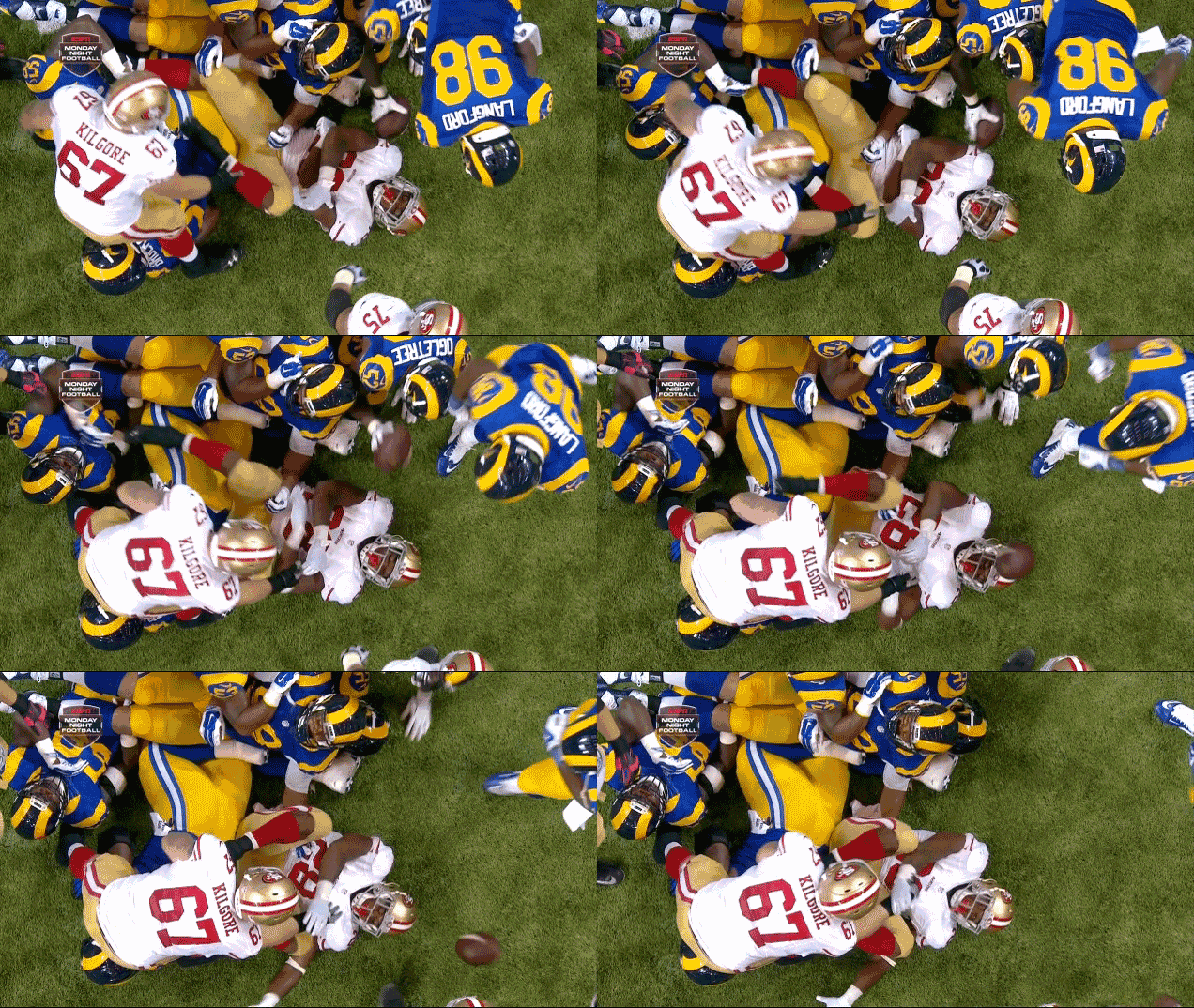
Video quiz: Battery on the football field?

Players in a contact sport consent to, or assume the risks of, the inherent risks of the game and its customs.  Intentional conduct outside the rules and customs of the game, on the other hand, may give rise to a valid claim.  Here is a clip from a recent NFL game.  The play has ended; the whistles have blown it "dead."  Watch what the St. Louis defender (Ogletree) does with the ball.  Battery? 


Thursday, September 11, 2014

Teenager charged with battery for kissing girl's hand without consent

For those of you who think that law professors' hypos have no basis in reality, here is a story from yesterday's headlines.  As reported by NBC Chicago and the Chicago Tribune
An 18-year-old Mundelein man has reportedly been charged after he allegedly kissed a girl’s hand without her consent. The man was sitting on a bus next to a juvenile girl on Aug. 27 when he asked her to give him a high-five, according to the Chicago Tribune. The girl gave the man a high-five and as she did so he allegedly grabbed her hand and kissed it. The man reportedly exited the bus in the 100 block of Hawthorn Center at Hawthorn Mall and was later arrested. The girl was not injured, the Tribune reported. Police said the man was charged with an ordinance offense for battery and is scheduled to appear in Mundelein Branch Court Thursday.
These facts combine the facts of at least two hypos I use in class and raise questions related to battery, intent, implied consent, and the scope of consent.  Discuss.

Sunday, August 31, 2014

Lawsuit claims $40 million in damages for injuries caused by police in Ferguson, Missouri

CNN is reporting that last Thursday five individuals arrested recently in Ferguson, Missouri, filed a lawsuit against Ferguson Police Chief Thomas Jackson, St. Louis County Police Chief Jon Belmar, Ferguson officer Justin Cosma, several unnamed officers and the city and county governments asking compensation for injuries caused by the police during the recent events in Ferguson.  The complaint includes claims for intentional infliction of emotional distress, negligence, assault and battery.  The CNN article has more details.

Wednesday, September 4, 2013

Magistrate reprimanded for kissing clerk

Here is a quiz for my students, from the pages of today's Legal Profession blog:

At the conclusion of a session of bond court, respondent kissed the clerk who had been working with him on the forehead. Respondent contends that the kiss was a gesture of appreciation for the clerk's hard work and that he in no way intended it to be an amorous gesture. However, respondent recognizes the clerk was offended by the gesture. The magistrate resigned when the clerk complained to the Chief Magistrate and was reprimanded by the South Carolina Supreme Court.

Is he subject to liability for battery?

Sunday, April 21, 2013

Supreme Court decides Milbrook v. US, recognizing cause of action against the federal government

About two months ago I commented on a case now before the US Supreme Court called Milbrook v. US in which the Court was asked to consider whether a plaintiff can recover under the Federal Torts Claims Act for injuries caused by law enforcement officers other than when they are executing a search, seizing evidence or making arrests for violations of federal law. See here, here and here.

The Court decided the case about three weeks ago and you can read the opinion here.  In an opinion by Justice Thomas, the Court held that the Federal Government is not immune from a claim for damages if the assaulting government officer was acting within the scope of his/her employment even if the officer was not making an arrest or seizing evidence at the time. 

For some comments on the opinion you can go to Torts Today and to Litigation and Trial.

Tuesday, March 5, 2013

US Supreme Court decides Levin v. US

Yesterday, the US Supreme Court issued its opinion in Levin v. United States in which the court had been asked to decide whether a civilian may bring a battery claim against the US government for injuries allegedly caused by military medical personnel during the performance of their duties, or, more specifically, whether such claims barred by sovereign immunity. 

Interpreting the statutes involved, the Court has held the plaintiff may bring the claim.  You can read the full opinion here.  Here is the syllabus:
The Federal Tort Claims Act (FTCA) waives the Government’s sovereign immunity from tort suits, . . .  but excepts from the waiver certain intentional torts, including battery, . . The FTCA, as originally enacted, afforded tort victims a remedy against the United States, but did not preclude suit against the alleged tortfeasor as sole or joint defendant. Several agency-specific statutes postdating the FTCA, however, immunized certain federal employees from personal liability for torts committed in the course of their official duties. One such statute, the Gonzalez Act, makes the remedy against the United States under the FTCA preclusive of any suit against armed forces medical personnel. . . .  Congress subsequently enacted comprehensive legislation, the Federal Employees Liability Reform and Tort Compensation Act (Liability Reform Act), which makes the FTCA’s remedy against the United States exclusive for torts committed by federal employees acting within the scope of their employment . . . Under the Liability Reform Act, federal employees are shielded without regard to agency affiliation or line of work.

Petitioner Levin suffered injuries as a result of cataract surgery performed at a U. S. Naval Hospital. He filed suit, naming the United States and the surgeon as defendants and asserting, inter alia, a claim of battery, based on his alleged withdrawal of consent to operate shortly before the surgery took place. Finding that the surgeon had acted within the scope of his employment, the District Court released him and substituted the United States as sole defendant. The Government moved to dismiss the battery claim, relying on the FTCA’s intentional tort exception. Levin countered that the Gonzalez Act. . . renders that exception inapplicable when a plaintiff alleges medical battery by a military physician. The District Court granted the Government’s motion to dismiss. 
The Court of Appeals for the Ninth Circuit affirmed but the Supreme Court reversed holding that the government is not immune and, therefore, Levin’s suit against the United States can go forward.  For all the relevant documents related to the case including briefs and opinions go here.

Monday, January 21, 2013

US Supreme Court to decide case on sovereign immunity for battery claims by medical personnel

Last week, the US Supreme Court heard oral arguments in Levin v. United States, in which the court has been asked to decide whether a civilian may bring a battery claim against the United States for injuries allegedly caused by military medical personnel during the performance of their duties, or, more specifically, whether such claims barred by sovereign immunity.

In this case, the plaintiff, a military veteran, claimed that a Navy physician performed an operation even though the plaintiff had withdrawn his consented to it.  The lower court held that the claim was barred by the exception in the Federal Torts Claims Act which retains sovereign immunity for certain intentional tort claims.  The plaintiff, however, argues that another statute provides an exception to the exception and that, thus, the state has waived its immunity.  This new statute is known as the Gonzalez Act, and the argument is based on section 1089(e) of the act which states that "[f]or purposes of this section, the provisions of section 2680(h) of title 28 shall not apply to any cause of action arising out of a negligent or wrongful act or omission in the performance of medical, dental, or related health care functions (including clinical studies and investigations)."  Section 2680(h) of title 28 is the section of the FTCA which retains immunity for battery.

The Ninth Circuit agreed that the plaintiff's reading of the Gonzalez Act is plausible, but concluded that Section 1089(e) did not waive the government’s immunity as to battery claims.  The Circuit Court's opinion is available here.  For a detailed discussion of the argument and the court's opinion go here.  For a review of the oral argument before the Supreme Court, go here.  For copies of all the relevant documents filed in the case, go here.

In his review of the oral argument, the author concludes that "[i]t appears likely that the Court will reverse the Ninth Circuit’s decision and hold that Section 1089(e) waives the government’s sovereign immunity as to claims like [the plaintiff's]".  Given the discussion of the issue, and the Court's past history, I am skeptical.  Whatever the decision, it will have important implications.  Stay tuned.

Monday, September 24, 2012

NFL refs, illegal hits and torts

If you are a football fan you know that the NFL referees have been locked out and the league is using substitutes and that there is a huge controversy over the quality of the work they are doing.  Also, there is a lot of talk about the fact that some players are playing much more violently because they think they can get away with it.  I did not watch much football yesterday, so I missed this bit of news when it happened but just heard of a hit on the Texans' quarterback by a Denver Broncos' defender which resulted in a serious injury to the QB.  According to the story, he will lose a little part of his left ear.

The refs did impose a penalty for the play, but the discussion now is whether the conduct was so far outside the lines that the injured player should have a claim for the injury.  Torts students who used the Prosser textbook may remember Hackbart v. The Cincinnati Bengals in which the court discusses the concept of consent to intentional torts in the context of organized sports.  According to the generally accepted view discussed in that case, players who voluntarily engage in organized sports agree to the inherent risks of the sport which includes conduct that violates the rules.

At some point, though, it could be argued that the conduct is so far outside the rules and customs of the game that it should be actionable.  If the player had purposely taken the QB's helmet off and then bit into his ear, a la Mike Tyson, I'd say you can argue for possible liability.  Likewise, maybe if the hit had happened some time after the play had been blown dead and the QB had let down his guard; but that would depend on how much time had passed.

But the case is much closer when the play is fast, before the whistle blows, even though the player goes for a hit to the head, etc.  Yes, the hit is illegal according to the rules but it is still a known risk of the game.  The video I saw of the play in question here, in my opinion, does not show a blatantly late hit.  It is not the lateness of the hit that was the problem.   It was the fact that it was clearly -in my opinion at least- to the head of the QB. 

Clearly, the fact the play is against the rules is not going to be enough to justify allowing possible liability.  What would be enough, is not all that clear, though. Professor Jonathan Turley has a good discussion of the question in his blog which you can read here

Tuesday, March 29, 2011

Police forget about teens left in van locked for fourteen hours

Prof. Jonathan Turley is reporting today that Police in Fort Lee, New Jersey are accused of locking a group of teens in a police van without heat (temperature was in the 20s) for 14 hours. The teens were rounded up at high school house party over the weekend and apparently forgotten until a passerby heard them screaming. The kids had to go to the bathroom in the crowded van. How many different types of claims do you think the teens could support based on these facts? For more go here and here.