As you know, the doctrine of qualified immunity recognizes a defense for certain government officials from liability for injuries caused by their conduct. It applies, for example, to prosecutors when they engage in investigative or administrative tasks, which is often limited to conduct before an indictment. And, of course, it applies to many other government officials when engaging in their official capacities.
The doctrine exists to provide protection to those officials so they can perform their duties without fear that their decisions will be later questioned or second-guessed by courts, a position that is justified by the principle of separation of powers.
The doctrine, however, is not particularly old and it is not universally accepted. The Cato Institute has referred to it as "an atextual, ahistorical doctrine invented by the Supreme Court in the 1960s" and as "a court‐confected doctrine that provides rights‐violating police and other government officials with an unlawful shield against accountability for their misconduct."
To do something about this, the Cato institute launched a strategic campaign to challenge the doctrine on March 1, 2018, the centerpiece of which has been a series of targeted amicus briefs urging the Supreme Court to reverse its precedents and eliminate the doctrine outright. In addition, the Institute has organized a massive cross‐ideological alliance of public interest groups opposed to qualified immunity. This "alliance" includes the ACLU, the NAACP Legal Defense Fund, the Alliance Defending Freedom and the Second Amendment Foundation.
I am writing about this today because yet another group has officially announced it will join the campaign. About two weeks ago (on Feb 15), The Wall Street Journal published an op‐ed by Institute for Justice Senior Attorney Robert McNamara, in which he describes IJ’s decision to join the battle against qualified immunity. You can read it here if you have a subscription.
For more on the CATO Institute's position on this issue go here.
Showing posts with label Defenses to intentional torts. Show all posts
Showing posts with label Defenses to intentional torts. Show all posts
Sunday, February 2, 2020

Friday, November 22, 2019
Can Mason Rudolph (Pittsburgh Steelers quarterback) support a claim for battery against Myles Garrett?
If you are a football fan, and maybe even if you are not, you probably heard about or saw the video of a fight at the end of the game between the Cleveland Browns and the Pittsburgh Steelers a couple about a week ago. At the end of the game, Myles Garrett (of the Browns) tore off Pittsburgh's quarterback Mason Rudolph’s helmet, and hit Rudolph in the head with it. The NFL quickly responded by suspending Garrett for the rest of the season. You can see the video here with the actual helmet to head contact here and here.
Could Rudolph support a claim for battery against Garrett?
In sports cases, it is often said that players consent to conduct that would otherwise constitute battery if the conduct is inherent to the sport. Likewise, if the claim were for negligence, it is often said that players assume the risks inherent to the sport. For this reasons, given the violence inherent to football most of the time players can't support a claim.
But, is the risk of having an opponent rip off your helmet and use it against you like a weapon inherent to the sport of football? I don't think so. I think the conduct in this case is so far outside the inherent risks of the game that the quarterback should be allowed to have a cause of action. What do you think?
Could Rudolph support a claim for battery against Garrett?
In sports cases, it is often said that players consent to conduct that would otherwise constitute battery if the conduct is inherent to the sport. Likewise, if the claim were for negligence, it is often said that players assume the risks inherent to the sport. For this reasons, given the violence inherent to football most of the time players can't support a claim.
But, is the risk of having an opponent rip off your helmet and use it against you like a weapon inherent to the sport of football? I don't think so. I think the conduct in this case is so far outside the inherent risks of the game that the quarterback should be allowed to have a cause of action. What do you think?
Tuesday, January 31, 2017
Do you remember Katko v Briney (the spring gun case)? Here is the lawyer who represented the defendant!
Way back when you took Torts, your probably read a case discussing whether a property owner can "defend" property from trespassers by using a spring gun. The case is in every Torts casebook I have reviewed, and Prosser's even has a photo of the defendant.
In any case, the defendant's lawyer was interviewed recently and you can read the interview here. The 93-year-old just retired after 66 years of practice. His reaction when Katko came to him with the case: "Damn, this will be fun."
Thanks to the TortsProf blog for the link.
In any case, the defendant's lawyer was interviewed recently and you can read the interview here. The 93-year-old just retired after 66 years of practice. His reaction when Katko came to him with the case: "Damn, this will be fun."
Thanks to the TortsProf blog for the link.
Tuesday, December 8, 2015
Charlie Sheen’s Ex-Fiancée Sues Over Sheen’s Failure to Disclose HIV Status; does she have a case?
Tuesday, September 15, 2015
Yet another disturbing video of football violence
Watch the defensive end of the team in the black uniform rip an opponent's helmet's off and then use it as a weapon against him.
According to NJ.com, this happened last weekend during a game between New Jersey high schools Immaculata and Linden. According to the story, the player who was hit with the helmet received 10 stitches after the game. Local police is looking into the incident.
According to NJ.com, this happened last weekend during a game between New Jersey high schools Immaculata and Linden. According to the story, the player who was hit with the helmet received 10 stitches after the game. Local police is looking into the incident.
Monday, September 14, 2015
Pac Man Jones will not be suspended for violence on the football field
Sunday I commented on the conduct of Bengals corner Adam “Pacman” Jones on the football field to illustrate the recurring issue of whether conduct while participating in sports could give rise to a claim for battery. As an update, it is now being reported that Jones will be fined but not
suspended.
Sunday, September 13, 2015
More violence in football
By now I am sure you are familiar with the story about the high school football players who attacked an official in the middle of a game last week. Well... here is another incident. For the second week in a row, a San Antonio-area high school is dealing with a player who hit an official in the middle of the game. Here is the video.
Not to be outdone, the pros began their season today and here is a video of Bengals player PacMan Jones ripping an opponent's helmet off and pushing the opponent's head into it after the play was over.
As in the story from last week, the torts issue is the same. Are these incidents within the scope of the consent to the "inherent risks" of the game? Is the conduct within the "customs" of the game?
UPDATE (9-14-15): It sounds like PacMan Jones will not be suspended for his conduct.
Not to be outdone, the pros began their season today and here is a video of Bengals player PacMan Jones ripping an opponent's helmet off and pushing the opponent's head into it after the play was over.
As in the story from last week, the torts issue is the same. Are these incidents within the scope of the consent to the "inherent risks" of the game? Is the conduct within the "customs" of the game?
UPDATE (9-14-15): It sounds like PacMan Jones will not be suspended for his conduct.
Sunday, September 6, 2015
Battery during football game or consent?
After just one day into the high school and college football season, we now have several examples of cheap shots and concussions to write about. However, the most disturbing is the play in the video below which shows two players in a high school team attack a referee. The incident took place during a game at Marble Falls High School,
northwest of Austin. The attacking players are from John Jay High,
in San Antonio's large Northside Independent School District. Their team was losing and the referee had called at least one penalty on the team before the two players apparently decided to take matters into their own hands.
As any first semester law student knows, there are some cases that discuss the fine line between battery and contact within the customs of a sport. In negligence language, it is often said that players assume the inherent risks of the sport. For the same reason, so do the umpires and refs. I don't think anyone would dispute that baseball umpires assume the risk of getting hit by balls, having runners run into them and getting yelled at or criticized by players. These are known risks. In football, some of the refs have to be positioned close to the plays and it is not uncommon to be pushed or run over.
However, I don't think that refs assume the risk of being intentionally attacked from behind by players. The conduct of the players involved in this video is inexcusable. They should be expelled from the team and if their conduct was suggested or even condoned by their coaches, they (the coaches) should be fired. There is no place for this in sports. Knowing what we know about concussions in football, this vicious attack on the ref could have caused him serious injury.
The Marble Falls Police Department is conducting an investigation and I will try to update this post when I hear more.
UPDATE (Sept. 7, 2015): ESPN is reporting that the two players who attacked the ref have been suspended from the team and from school pending the investigation. It also reported that the Austin Football Officials Association wants to make sure the two players are not allowed to play football again. I would support that decision. Slate also has the story here. NPR has an update here.
UPDATE (Sept. 8): Slate is now reporting two new pieces of information: the students are claiming the ref used a racial slur toward them and the school district it is treating the incident as an assault on a school official, an offense that could lead to expulsion.
As any first semester law student knows, there are some cases that discuss the fine line between battery and contact within the customs of a sport. In negligence language, it is often said that players assume the inherent risks of the sport. For the same reason, so do the umpires and refs. I don't think anyone would dispute that baseball umpires assume the risk of getting hit by balls, having runners run into them and getting yelled at or criticized by players. These are known risks. In football, some of the refs have to be positioned close to the plays and it is not uncommon to be pushed or run over.
However, I don't think that refs assume the risk of being intentionally attacked from behind by players. The conduct of the players involved in this video is inexcusable. They should be expelled from the team and if their conduct was suggested or even condoned by their coaches, they (the coaches) should be fired. There is no place for this in sports. Knowing what we know about concussions in football, this vicious attack on the ref could have caused him serious injury.
The Marble Falls Police Department is conducting an investigation and I will try to update this post when I hear more.
UPDATE (Sept. 7, 2015): ESPN is reporting that the two players who attacked the ref have been suspended from the team and from school pending the investigation. It also reported that the Austin Football Officials Association wants to make sure the two players are not allowed to play football again. I would support that decision. Slate also has the story here. NPR has an update here.
UPDATE (Sept. 8): Slate is now reporting two new pieces of information: the students are claiming the ref used a racial slur toward them and the school district it is treating the incident as an assault on a school official, an offense that could lead to expulsion.
Wednesday, October 15, 2014
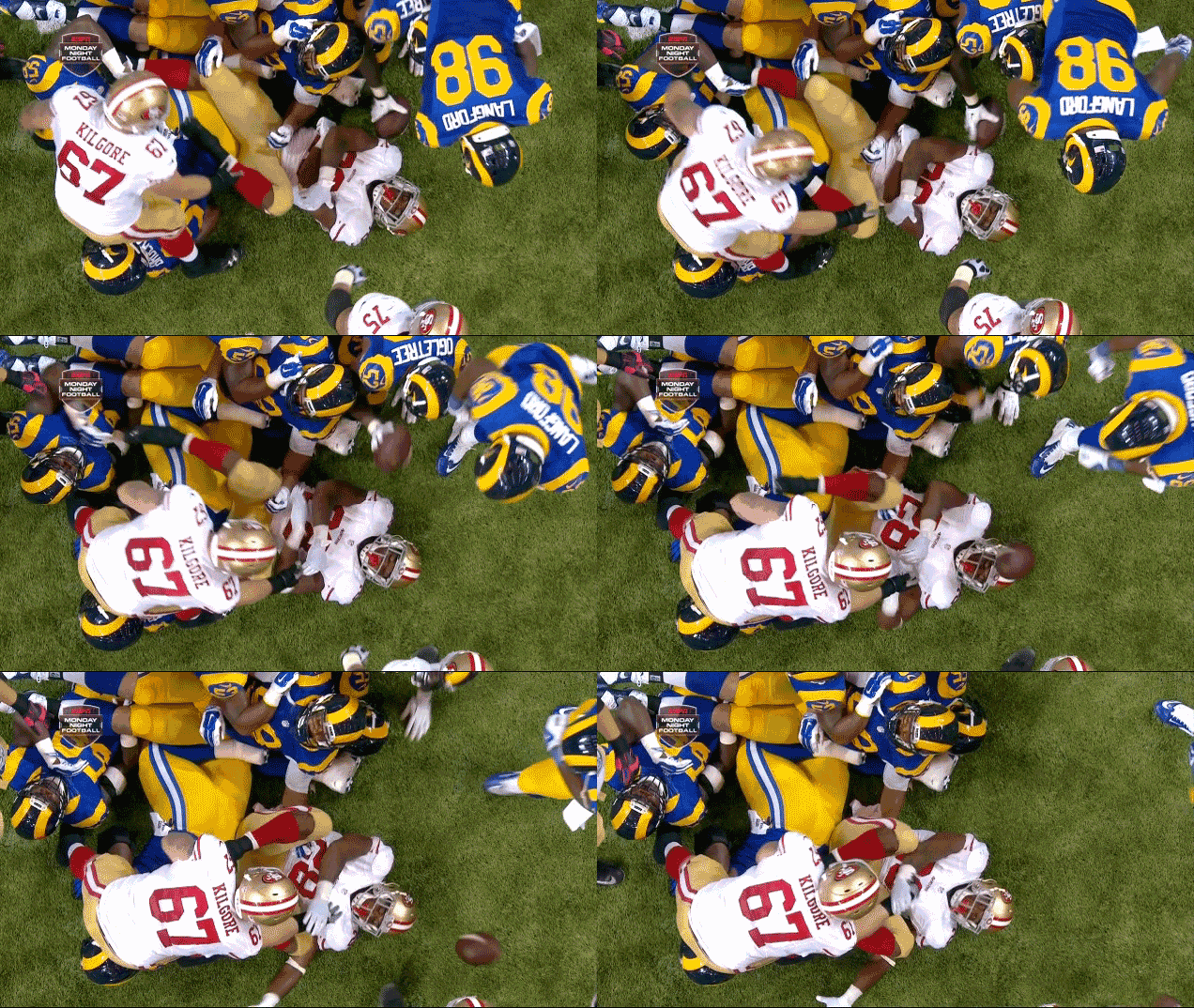
Video quiz: Battery on the football field?
Players in a contact sport consent to, or assume the risks of, the inherent risks of the game and its customs. Intentional conduct outside the rules and customs of the game, on the other hand, may give rise to a valid claim. Here is a clip from a recent NFL game. The play has ended; the whistles have blown it "dead." Watch what the St. Louis defender (Ogletree) does with the ball. Battery?
Monday, September 24, 2012
NFL refs, illegal hits and torts
If you are a football fan you know that the NFL referees have been locked out and the league is using substitutes and that there is a huge controversy over the quality of the work they are doing. Also, there is a lot of talk about the fact that some players are playing much more violently because they think they can get away with it. I did not watch much football yesterday, so I missed this bit of news when it happened but just heard of a hit on the Texans' quarterback by a Denver Broncos' defender which resulted in a serious injury to the QB. According to the story, he will lose a little part of his left ear.
The refs did impose a penalty for the play, but the discussion now is whether the conduct was so far outside the lines that the injured player should have a claim for the injury. Torts students who used the Prosser textbook may remember Hackbart v. The Cincinnati Bengals in which the court discusses the concept of consent to intentional torts in the context of organized sports. According to the generally accepted view discussed in that case, players who voluntarily engage in organized sports agree to the inherent risks of the sport which includes conduct that violates the rules.
At some point, though, it could be argued that the conduct is so far outside the rules and customs of the game that it should be actionable. If the player had purposely taken the QB's helmet off and then bit into his ear, a la Mike Tyson, I'd say you can argue for possible liability. Likewise, maybe if the hit had happened some time after the play had been blown dead and the QB had let down his guard; but that would depend on how much time had passed.
But the case is much closer when the play is fast, before the whistle blows, even though the player goes for a hit to the head, etc. Yes, the hit is illegal according to the rules but it is still a known risk of the game. The video I saw of the play in question here, in my opinion, does not show a blatantly late hit. It is not the lateness of the hit that was the problem. It was the fact that it was clearly -in my opinion at least- to the head of the QB.
Clearly, the fact the play is against the rules is not going to be enough to justify allowing possible liability. What would be enough, is not all that clear, though. Professor Jonathan Turley has a good discussion of the question in his blog which you can read here.
The refs did impose a penalty for the play, but the discussion now is whether the conduct was so far outside the lines that the injured player should have a claim for the injury. Torts students who used the Prosser textbook may remember Hackbart v. The Cincinnati Bengals in which the court discusses the concept of consent to intentional torts in the context of organized sports. According to the generally accepted view discussed in that case, players who voluntarily engage in organized sports agree to the inherent risks of the sport which includes conduct that violates the rules.
At some point, though, it could be argued that the conduct is so far outside the rules and customs of the game that it should be actionable. If the player had purposely taken the QB's helmet off and then bit into his ear, a la Mike Tyson, I'd say you can argue for possible liability. Likewise, maybe if the hit had happened some time after the play had been blown dead and the QB had let down his guard; but that would depend on how much time had passed.
But the case is much closer when the play is fast, before the whistle blows, even though the player goes for a hit to the head, etc. Yes, the hit is illegal according to the rules but it is still a known risk of the game. The video I saw of the play in question here, in my opinion, does not show a blatantly late hit. It is not the lateness of the hit that was the problem. It was the fact that it was clearly -in my opinion at least- to the head of the QB.
Clearly, the fact the play is against the rules is not going to be enough to justify allowing possible liability. What would be enough, is not all that clear, though. Professor Jonathan Turley has a good discussion of the question in his blog which you can read here.
Tuesday, March 29, 2011
Police forget about teens left in van locked for fourteen hours
Prof. Jonathan Turley is reporting today that Police in Fort Lee, New Jersey are accused of locking a group of teens in a police van without heat (temperature was in the 20s) for 14 hours. The teens were rounded up at high school house party over the weekend and apparently forgotten until a passerby heard them screaming. The kids had to go to the bathroom in the crowded van. How many different types of claims do you think the teens could support based on these facts? For more go here and here.
Friday, March 11, 2011
Violence in professional ice hockey
By now you have probably heard the news (also here) that authorities are considering bringing criminal charges against a professional hockey player for a hit on an opposing player.
Although, not a torts issue (yet!), the event reminds me of Hackbart v. The Cincinnati Bengals, which we discuss in class to cover the issue of consent to intentional conduct. In that case, a football player sued an opponent who hit him after the play was over.
Here is more on the torts angle to the story.
Friday, September 3, 2010
Video Quiz
Here is a video quiz. How many torts can you spot? (If you are getting this by email, you may have to go to the actual website to see the video). According to reports I have read, the video was taken during an early round tennis match at the US Open. Apparently, the young man arguing with the woman had been swearing loudly and acting obnoxious in the stands before being confronted by the woman. I imagine she asked him to "watch his language" or something like that. This, as recorded by another fan in the stands, is what happened next:
Thanks to Jonathan Turley for the link to the video.
Thanks to Jonathan Turley for the link to the video.
Saturday, September 12, 2009
More on the right to use force to defend property and in self defense
Prof. Jonathan Turley has a series of posts on his website on recent developments in this area.
For example, go here for a report of a recent case in Montana in which Prof. Turely explains that "For years, legislators have been passing “castle doctrine” laws or “Make My Day laws” that allow homeowners to use lethal force against anyone who enters their home. While these laws have produced a wide range of controversial shootings (here and here and here and here and here and here), legislators have continued to expand their scope to businesses, cars, and other areas while also expanding the right to carry concealed weapons into churches, bars, schools, school games and workplaces. Some of these laws are called “Make My Day Better laws,” which allow the use of lethal force outside of the home to repel criminals. Montana’s law has sweeping language to protect the “natural right” to use lethal force."
Go here for a dicussion of a similar case out of Texas and here for a note on a case in England.
Friday, September 11, 2009
Defense of property, self defense, defense of others etc
The other day in class we discussed the different "privileges" or "defenses" to intentional torts including the so-called "shopkeeper's privilege" and the rights to self defense, to defend others, to defend property and to recover property. By coincidence, I just came across this video in another website, which in a way seems to implicate most of them. It shows the same scene from 4 different angles. The first one suggests a robbery. Keep watching....
Monday, February 9, 2009
Home-invasion death suit settled
This item is not particularly remarkable other than the fact that it deals exactly with what we were talking about in class today.
A few days ago, it was reported that a federal civil lawsuit filed against a homeowner who shot and killed two home invaders in 2005 has been settled. The wrongful-death lawsuit was filed by the parents of two young men who were shot and killed as they fled the home of the defendant. For more details on this story (although there aren't that many) go here.
Subscribe to:
Posts (Atom)